Preparing for Space : In this image from 2009, NASA astronaut Stephanie Wilson is attired in a training version of her shuttle launch and entry suit. (via NASA)
Located 5500 light years away from Earth, in the constellation Scorpius, this gorgeous nebula is alternatively known as the Lobster Nebula or the War and Peace Nebula. [via]
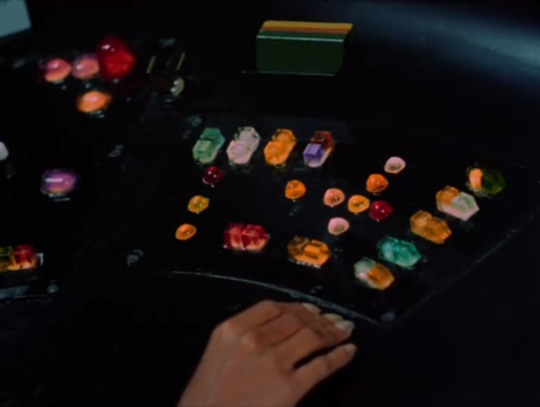
I’m no longer holding Star Trek or Star Wars “accountable” for their clunky-looking sixties-and-seventies future technology.
Why?
Because the Enterprise is off on a years-long voyage through space. There’s no Verizon store, no Radio Shack, no Geek Squad out there. If the Klingons fire photon torpedoes and the bridge shakes and Spock’s head bangs against the fancy iPad72 touchscreen and cracks the glass, the ship’s toast. If Han Solo’s fingerprints get all over the starchart and the touch-calibration is off by half a centimeter, the Falcon is going right into a star. But if Mister Worf accidentally twists the command knob too hard and pops it off, he can just screw that thing right back on and it will keep working. Dust gets in there? Take it apart and clean it out. All the plugs are big and universal, all the power cells are functional and have a decent battery life, and nothing is built to expire in the next six months so you have to buy a new one.
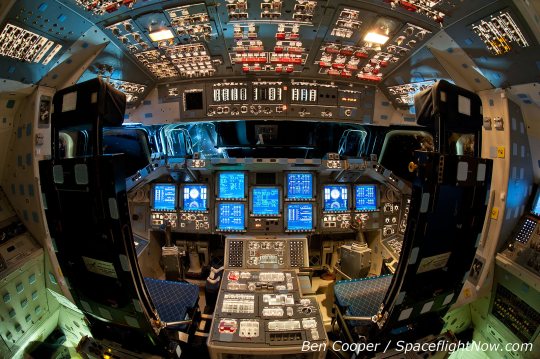
That tech isn’t anachronistic or suffering a bad case of Zeerust–it’s practical, effective, and it works. Apple tried launching its own space exploration craft, it had to come back for full repairs within three months, and then it had to be upgraded over the next two.
But this? This is just good, long-lasting, fully-functional, and reliable craftsmanship.
The actual real-life space shuttles’ electronics looked pretty much like that for their entire lifespan and this is exactly why.
These mosaics of the Saturn moon Titan’s surface were constructed using data gathered over 13 years by the Visual and Infrared Mapping Spectrometer instrument aboard NASA’s Cassini spacecraft. [5448 x 3686]
Venus and the Triply Ultraviolet Sun : An unusual type of solar eclipse occurred in 2012. Usually it is the Earth’s Moon that eclipses the Sun. That year, most unusually, the planet Venus took a turn. Like a solar eclipse by the Moon, the phase of Venus became a continually thinner crescent as Venus became increasingly better aligned with the Sun. Eventually the alignment became perfect and the phase of Venus dropped to zero. The dark spot of Venus crossed our parent star. The situation could technically be labeled a Venusian annular eclipse with an extraordinarily large ring of fire. Pictured here during the occultation, the Sun was imaged in three colors of ultraviolet light by the Earth-orbiting Solar Dynamics Observatory, with the dark region toward the right corresponding to a coronal hole. Hours later, as Venus continued in its orbit, a slight crescent phase appeared again. The next Venusian transit across the Sun will occur in 2117. via NASA



 wrennette