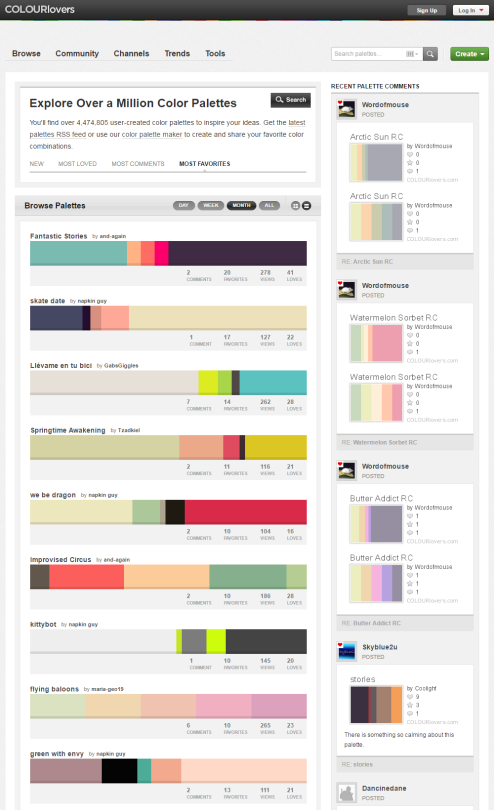
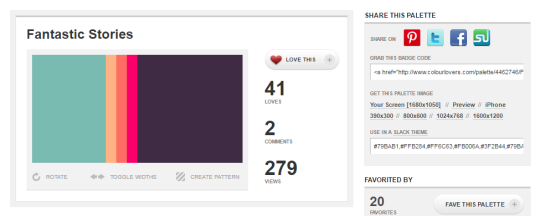
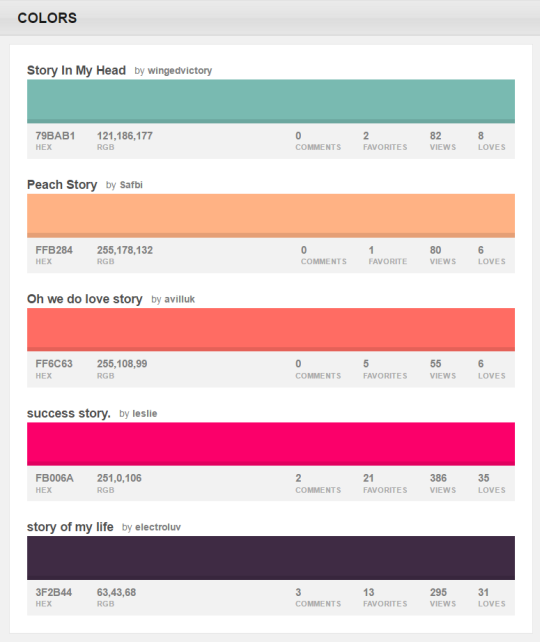
You can browse the most popular ones or search for certain colors, themes, and even specific hex codes!
When you find one you like, you can download a wallpaper swatch of it and also select the specific colors it uses to look at more palettes that use those same ones.
STAR WARS: THE CLONE WARS Character Encyclopedia (DK) (2010): CLONES!!!! + Stats and Fun Facts (PART 2/2): FEATURING: Jet, O’niner, Punch, Ponds, Razor, Kickback, Wolffe, Stone, Sketch, Swoop, Thire, Rys, Rex, Waxer, Tucker, Fil, Tucker, Slick, Stak (Note: This book falls under Legends, so it is not canon, but it’s still a ton of fun! It’s also only based on the first two seasons at the time of publication!)
Punch’s soul patch is “kept immaculate”.
“Ponds serves under Mace Windu, often on Coruscant overseeing the course of the war. This has left Ponds far from the front. He wears his frustration on the back of his helmt, where he’s scrawled, ‘Some Guys Have All The Luck.’"
“No one is happier than Ponds when Mace Windu is sent to Ryloth for the Republic’s invasion of the Separatist-held planet. Ponds finally sees action at Nabat and Lessu, leading the troopers of Lightning Squadron against Wat Tambor’s forces.”
“Razor and his squadronmate Stak were trained on Kamino before their first battle, but they ahve learnt much more by fighting alongside Mace Windu. Where their Jedi general leads, Razor and Stak will follow.”
“Rys has spent a good chunk of the war on Coruscant, escorting Senators and monitoring fleet movements in the Outer Rim.”
“The other pilots in Blue Squadron think Tucker is a bit crazy for saying so, but he has always found space combat beautiful. Starfighters spin and whilr as they jockey for position, lit by colorful flashes of explosions and laser fire.”
Members of Blue Squadron (under Ahsoka Tano’s command) are: Swoop, Kickback, Slammer, and Tucker
Members of Lightning Squadron (under Mace Windu’s command) are: Ponds, Razor, and Stak
Members of Gold Squadron (under Anakin Skywalker’s command) aren’t listed
Members of Green Squadron (under Saesee Tiin) aren’t listed
Members of Gold Squadron (under Anakin Skywalker’s command) aren’t listed here, but include: Matchstick, Broadside, Tag, and Contrail
Members of Torrent Company (under Anakin Skywalker as General, Ahsoka Tano as Commander), which was a sub-unit of the 501st, aren’t listed here but include: Rex,
Members of the 501st were grouped into several sub-units, including Rex’s Squad: Rex, Fives, Tup, Jesse, Kix, and Hardcase
Members of the 7th Sky Corps (under Obi-Wan Kenobi) aren’t listed here but include: Cody, Boil, Waxer, Wooley, Trapper, Longshot, Gearshift, Crys
The 212th was a division of the 7th Sky Corps, which included the above, as well as the sub-unit Foxtrot with Gregor and Ghost Company with Cody, Boil, Waxer, and Wooley.
“Steven Caple Jr., the director of Jordan’s next film, Creed II, calls this moment of black solidarity in Hollywood a ‘movement.’ During the filming last March, Jordan and Caple often talked about black historical figures whose stories might make a great movie or TV series, like Fred Hampton, the Black Panther who was murdered in his apartment in 1969, or Mansa Musa, a Malian historical figure of the 14th century known to many African-Americans but virtually unknown to white people. Musa was reputedly one of the richest men in the world. ‘When people look at black people it’s hard for them to think beyond slavery,’ says Caple.
“’We don’t have any mythology, black mythology, or folklore,’ Jordan explains to me as we cruise past billboards for Atlanta and HBO’s Ballers in West Hollywood. DJ Khaled’s ‘I’m the One’ is on the car stereo, and I notice Jordan’s iPhone alias is ‘Bruce Leroy,’ the black martial-arts hero of the 1985 film The Last Dragon. ‘Creating our own mythology is very important because it helps dream,” says Jordan. “You help people dream.’”
Context. I’m assuming he meant we don’t have any Black mythology/folklore in TV and films. It’s half true. There have been movies made, but it’s only a very small handful. Films like Eve’s Bayou, Daughters of the Dust, and Beloved (an adaptation of Toni Morrison’s book of the same name) quickly come to mind that contain folkloric/mythological elements.
The way the writer for Vanity Fair left his statement lingering and didn’t ask further questions so he could fully flesh out his thoughts without leaving one to guess what he was referring to since the mention of popular tv show billboards followed his statement is failed journalism. White journalism. TF we need to know about what was on the radio and his phone in that moment?!…
Here’s some further readings about Black folklore / mythology:
The tweet that mentions the film, To Sleep With Anger, here’s the full thread. Insightful and very detailed.
The Origin of Zombies and More: “Zombie folklore has been around for centuries in Haiti, possibly originating in the 17th century when West African slaves were brought in to work on Haiti’s sugar cane plantations. Brutal conditions left the slaves longing for freedom. According to some reports, the life—or rather afterlife—of a zombie represented the horrific plight of slavery.” (Source: www.history.com)
“The Tragic, Forgotten History of Zombies”: The horror-movie trope owes its heritage to Haitian slaves, who imagined being imprisoned in their bodies forever. (Source: The Atlantic)
Anansi is an Akan folktale character. He often takes the shape of a spider and is considered to be the spirit of all knowledge of stories. He is also one of the most important characters of West African and Caribbean folklore. (wikipedia)
A Boo Hag is a mythical creature in the folklore of Gullah culture. It is a regionalized version of the Hag myth. According to the legend, Boo Hags are similar to vampires. (wikipedia)
STAR WARS: THE CLONE WARS Character Encyclopedia (DK) (2010): CLONES!!!! + Stats and Fun Facts (PART ½): FEATURING: Bly, Axe, Cody, Denal, Cut Lawquane, Boil, Echo, Chopper, Fox, Fives, Gree, Broadside, Gus, Boost, Hevy, Jek, Hawk, Jester, Oddball, Matchstick (Note: This book falls under Legends, so it is not canon, but it’s still a ton of fun! It’s also only based on the first two seasons at the time of publication!)
Clone pilots must have superior vision.Pilots are superstitious and most have rituals they follow to make sure they return to base safely.
Waxer enjoys mocking Boil’s fancy mustache!
Few Jedi and clone officers develop a bond as close as the one between Obi-Wan Kenobi and Commander Cody. Engagements at places such as Ryloth, Black Stall Station and Geonosis have taught Cody to respect Obi-Wan’s skill as a warrior, and obi-Wan has come to trust that Cody will never let him down. (HA HA HA WHAT THE FUCK YOU DIDN’T HAVE TO COME FOR ME LIKE THAT, STAR WARS, DOES EVERYONE OBI-WAN BELIEVE IN BETRAY HIM?)
Chopper collects the fingers of fallen battle droids as grim trophies.
Gree’s nickname reflects his interest in studying alien cultures, which he studies in hopes of learning new lessons about military strategy.
Broadside and his friend Matchstick the good luck charm is to take turns agreeing to buy the drinks when they make it through each new Republic mission.
Gus’ “rakish goatee is carefully tended”.
The double stripes on Boost’s head are to honor fallen clones.
Jek has memorized the manual for every weapon in the clones’ arsenal.
Ok this is a real quick one but let me show you how to get more-or-less accurate sizes for child characters.
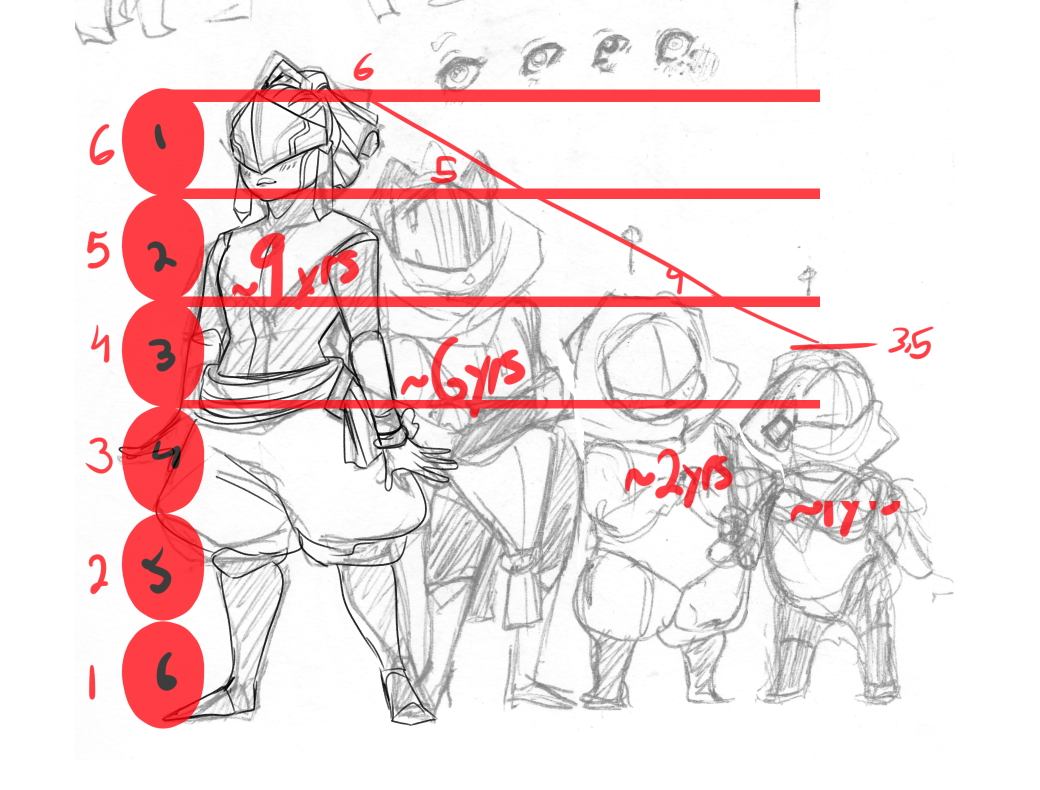
Kids are tricky to draw, they are – from toddler up to about teens people change radically almost every year so pinpointing character’s size during those years is pure hell.
What you need to do to make everything super easy for yourself is to check their Head Proportion. What makes kids look like – well, kids, is that their heads are proportionally large in comparison to their body.
Average adult is about 7,5 heads tall in comparison to their own body, however with children under 10 that number is just under 6 heads with about 1 head shorter the younger you go down to 3 heads as an infant.
Easiest way to figure the so-so head-height of a certain age is to find images of said age group and do a quick count on them
at which after you can replicate it in your own works – don’t mind if it’s not 1:1 with reference, finding images that are actually of the age you need is tricky and kids in general vary a lot so someone might be a lot taller than others. You have a bout 0,5 -1 heads of wiggle room before it starts to look way older.
Proportions are super important in art and i lovingly recommend everyone to figure out basics of them – it’s the easiest way to get notifically better with art. I could go on about proportions but let’s wrap this up.
Need to note however that head proportion is not same as character height – a character can be 15 feet tall but still have head-height of 6, HH is simply a way to scale out the body.
I discovered something useful today, taking breaks or exercising never helps me but THIS does, sharing to save a life
I just found out that some pro artists that work for companies like Dreamworks etc sometimes hold their pens this or similar way so it gotta work. Recently I spent 5 days on drawing for long periods of time (we talk about min 5 hours in one go to max 12 hours long crunch) and not once did my hand bother me.
After getting the Han Solo Card Game that recreates the Corellian Spike variant of Sabacc, I noticed it was easy to play and heaps of fun. Too bad I spent almost $50 (AUD) on it… Because you can very easily play it with a normal deck of cards.
Things you’ll need:
1: A deck of cards
2: A pair of dice
The first thing you will need to do is remove all the face cards (King, Queen, Jack) but keep the jokers in. They represent the sylops cards that there are only 2 of in Corellian Spike deck which represent 0. A Corellian Spike deck has 62 cards in it and a normal deck has 52, so you’ll be playing with 36 cards after removing the face cards. You could buy 2 identical decks and make it so there are 2 jokers and 6 of each number card, 30 positive and 30 negative. Black being positive and Red being negative.
Now with the deck prepared, here’s how you play. Each player takes turns being the dealer, rotating clockwise around the table (left of the dealer). The first thing you do is shuffle the deck (duh), then deal 2 cards to each player. Place the deck in the middle of the table and take the top card from that pile and place it face up next to it. This is the discard pile. Remember, the goal is to get as close to 0 as possible.
Here’s where the rules start to deviate from the Han Solo Card Game. Because you don’t have the credit chits (which have items on the backs and how much they’re worth) you’d start a betting round. Each player has the chance to make a bet going clockwise (left of the dealer). You have the option of having a small blind and big blind if you’d like. You could use chips, from the packet or poker style, or not have a betting round and play for fun.
After everyone has made a bet, the dealer has the first turn. Here are your options straight from the card game rule book:
Take the top card from the draw pile. If you want to, you can also place a card from your hand on the discard pile.
Take the top card from the discard pile.
If you want to, you can also place a card from your hand on the discard pile.
Do nothing. This is known as “standing”.
Remember that you CANNOT place a card in the discard pile if you did not take a card from either pile.
Next is the player to the left’s turn, then the player to their left, and so on until the player to the right of the dealer has had their turn. The dealer then roles the 2 dice. If it lands with 2 matching numbers, then everyone remembers how many cards they have, discard them face up in the discard pile, and the dealer deals each player the amount of cards they had before.
Then another betting round starts and then the dealer has their turn and so on. After each player takes their second turn, roll the dice again, and again after all players have had their third turn.The round is then over. The winning hand is the one closest to 0. It says in the rules that a positive score beats an equally negative score, ie: a hand of 5 beats a hand of -5. But I don’t like that because they’re both 5 away from 0 so decide with your group before the game if you want to house rule that rule out or keep it in. If there is a draw, players with the same hand draw a card from the draw pile and the closest card to 0 wins that tie.
Then you start again with the dealer changing clockwise for the next round. A good way to establish how long the game will last is to decide how many times each player will be the dealer. Once for a short game, twice for a twice as long game, etc.
Make sure the system you use matches the kind of players you have, for an optimal experience
Admin Note: This is part of the ongoing series called “D&D isn’t the only TTRPG if you don’t want fantasy play another goddamn game!”
I already reblogged this once but this is important:
Like I run a D&D blog. I understand that D&D is the most well-known and popular RPG in the world. But a lot of the time I see people going like “Hey I want to run a D&D campaign and throw out all the D&Disms and here’s all the notes I have for running a campaign about courtly romance and chivalry in a historical setting” and I’m just like STOP YOU DON’T NEED TO RUN THIS USING D&D
There’s a sort of a mistaken assumption that because D&D is the biggest game on the market and that it’s fantasy that it should be the go-to fantasy game but look it’s not D&D isn’t a generic fantasy game it’s a very specific kind of fantasy all of its own, one that steals liberally from swords & sorcery and high fantasy and adds fucking extradimensional cube robots for good measure
So next time you’re thinking about a fantasy campaign in a decidedly non-D&Dish setting consider instead of jamming the square peg that is D&D into a round hole trying to find a system that actually supports what you’re trying to do
And this is not to say that you shouldn’t play D&D: D&D is hella fun. But there’s a lot of genres and styles that D&D does a piss-poor job of doing, and because of that it’s so good we’ve got other games
*cracks knuckles*
All right then. I’ve been meaning to dust off my own D&D sideblog for a while, so here we go with providing some examples. I’m limiting this specifically to other types of fantasy outside of the standard high fantasy and sword & sorcery millieu.
Courtly Romance and Chivalry
There are a number of options for this, and they range from standard secondary world fantasy to more historical and mythological settings. My list here shouldn’t be treated as fully extensive.
Blue Rose – based on the romantic fantasy subgenre, specifically as seen in the works of Tamora Pierce and Mercedes Lackey. A lot of courtly drama and intrigue and swashbuckling, based in a fictional world.
Pendragon – naturally based off of Arthurian mythology, and having a lot of stuff given over to the court of Camelot and the chivalric adventures of the various knights. The same company also has a kickstarter for a spin-off called Paladin: Warriors of Charlemagne that might be worth checking out.
Historical Fantasy
This one’s a bit more prominent as historical settings serve as an inspiration for a variety of fantasy worlds and games, and this of course invariably extends to settings that actually use historical settings with a degree of fantasy elements thrown in. Note that I’m going to emphasise Europe here simply due to greater familiarity with games in that millieu, and as a European myself I’m ill-equipped to judge how accurate or respectful games using other settings actually are.
Because of this, feel free to add other examples in reblogs
Chivalry & Sorcery – one of the early tabletop games inspired by D&D, taking a more pseudo-historical approach.
It’s based on 12th century France and strives for a degree of historical accuracy and medieval politics.
World of Darkness, Dark Ages (including Vampire and Mage) – while the World of Darkness has earned some negative attention lately (and for good reason), the dark ages RPGs are still an old favourite of mine. Also worth checking out is Mage: The Sorcerer’s Crusade, set during the Renaissance. The Mage stuff has a really cool open-ended magic system worth checking out.
Ars Magica – this exists along very similar lines to the dark age material above, based around mages and magic-users in a ‘Mythic Europe’ setting. It also has a really cool open-ended magic system, and one of my personal favourites.
Awwww shit heck yes I might want to add to this list but this is a really good starting point
The native Maori people of New Zealand have tattooed their faces for centuries. They had a complex warrior culture before the arrival of Europeans, and suffered under early colonialism, but have experienced a cultural revival since the 60′s.
The marks are called moko, and are etched with chisels instead of needles to leave grooves along with the ink. The true form is sacred, unique to each person, and distinct from European tattoos that mimic that traditional style.
There arent many pictures non combat related that look this badass
Actually most
Tā moko are done with modern tattoo equipment these days, but some people get them done the traditional way. And, as others have said, they’re not for Non-
Māori, as they have specific meanings and significance. If you want a tattoo with Māori
style, you can get a
kirituhi. These avoid any designs associated with particular tribes or famous people you’re not related to.
Kirituhi is a Māori style tattoo either made by a non-Māori tattooer, or made for a non-Māori wearer. Kirituhi has mana of it’s own and is a design telling the unique story of the wearer in the visual language of Māori art and design. Kiri means ‘skin’, and tuhi means ‘to write, draw, record, adorn or decorate with painting’.
Kirituhi is not restricted to only Māori people, and it is a way for Māori to share our cultural arts with people from around the world in a respectful manner, and for non-Māori artists to enjoy our beautiful art form as well. I happily do kirituhi for my clients around the world and it is a privilege to do such work for them.
Kirituhi is no lesser an artform than moko, however it is different and I believe these differences must be acknowledged and respected, so that the integrity of our taonga Māori – moko, is maintained around the world.
Moko is uniquely Māori and it is strictly reserved to be done by Māori, for Māori.
If either the recipient or tattooer do not have Māori whakapapa, then the resulting design is a Māori Style tattoo or kirituhi, NOT moko. The word moko originated from the Māori atua (god) of volcanic activity and earthquakes, Rūaumoko – therefore the origin of tā moko is divine and sacred – to me this is no small thing, nor should it be dismissed.
As my mentor once told me, ‘moko is about 99% culture, and 1% tattoo’.



 wrennette