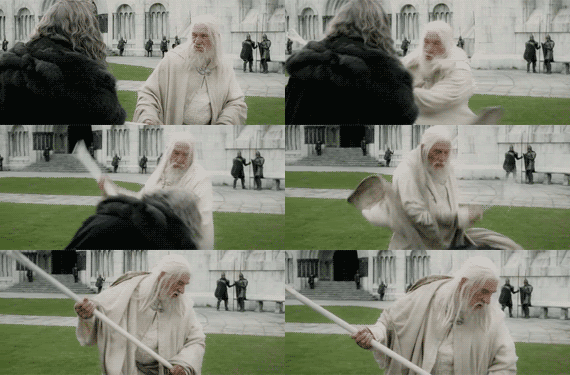
If you find yourself in times of trouble, ask yourself, ‘what would Gandalf do’, and remember, ‘beat a man unconscious with a big stick’ is a valid answer
When I find myself in times of trouble, Gandalf Greyhame comes to me, Wailing on those assholes, With a tree (with a tree)
Long we have tended our beasts and our fields, built our houses, wrought our tools, or ridden away to help in the wars of Minas Tirith. And that we called the life of Men, the way of the world. We cared little for what lay beyond the borders of our land. Songs we have that tell of these things, but we are forgetting them, teaching them only to children, as a careless custom. And now the songs have come down among us out of strange places, and walk visible under the Sun.
So I get really narky when people pull the whole ‘oh Eowyn’s
storyline came to such a sucky ending; she was really cool going around killing
orcs and Witch-Kings and then she got shoved into a traditional girly role by marrying
Faramir and becoming a healer’ thing, because no. No-no-no-no-no. Not only does that
stray dangerously into the territory of ‘women only have worth if they’re doing
traditionally blokey things’, but that misses almost the entire point of Lord of the Rings.
Tolkien was in the trenches in the first world war, right?
He got all that ‘for death and glory’ shit shoved down his throat, that was the
whole point about the war, it was when so many people came to see how awful and
misleading all the propaganda about winning glory through violence and death was. And Tolkien’s work completely shows
that: it’s why the hobbits, who’ve never craved power or battle the way men do,
are the heroes of the book; it’s
why strong men like Aragorn and Faramir are shown to be lovers of peace rather
than war. It’s why the quote – but I do not love the bright sword for its sharpness, nor the arrow for
its swiftness, nor the warrior for his glory; I love only that which they
defend – is so poignant and beautiful, when
seen in the context of all Tolkien had gone through. He’d seen all but one of
his closest friends die in an utterly pointless war; the prevalent message in
his books is ‘if you’re going to have that many people die, let it be for
something worth dying for.’ (Like
defending your home from the lord of all darkness, for example.)
And Eowyn
might be a fantastic female character, but she’s also got so much development
to go through, and she’s by no means perfect. I find it really interesting that when Eowyn talks to Aragorn
about wanting to go off and fight she never really actually mentions protecting
her people, but speaks about wanting to ‘face peril and battle’, and to
do ‘great deeds’. And it’s not that Eowyn doesn’t want to protect her people, because of course she does, but she’s also got such a
driving motivation within her to do glorious and fell deeds simply for the sake
of valour and renown. It’s one of her defining features, having an attitude
that got so many young men killed in the war and which, obviously, Tolkien
would have been very wary of.
(Also, I think, there’s so much in Eowyn that wants to prove
herself to be more than ‘a mere woman’; because twice in that conversation she
asserts that she’s no mere ‘dry-nurse’ or ‘serving-woman’, but a member of the
house of Eorl and therefore capable of greater things. There’s almost this
slight sense of Eowyn considering herself more than ‘just’ a domesticated woman that I
sometimes get from her in the books? Which is very sad – the idea of Eowyn having less regard for others of her sex who do mind the house or raise the children – and why I so love that ‘I am no man’ moment in RotK. Eowyn’s no longer hiding herself, or dismissing fellow women as the weaker sex,
but acknowledging and embracing the fact that women in all their forms can fuck you up.)
And then we reach
the Houses of Healing, and Eowyn yearning for death in battle just like her
Uncle Theoden, and basically buying into that whole world war one ethos that
Tolkien would have considered so poisonous. Which is why her friendship and
courtship with Faramir is so fricking beautiful.
Remember that quote I wrote earlier? That’s from Faramir. He’s not backing down
from conflict, he’s in no way less of a ‘real man’ than anyone else; he’s just
saying there needs to be more to the fight than simply having a fight. There needs to be a reason; something worth
fighting for. Eowyn recognises that Faramir is a good man in every sense of the
word: he’s strong and valiant, but he doesn’t fight simply to prove himself or
for the sake of winning glory, he fights for other people. And Faramir gently challenges Eowyn on her
idolisation of battle-glory and encourages her not to scorn gentleness or
peace, and he’s so freaking good for her.
(Seriously. Can we just stop for a moment and think about how
wonderful Eowyn and Faramir are for each other: Faramir encouraging Eowyn to
turn towards life and healing and openness while never denying her strength or courage, and Eowyn giving Faramir the
validation and security he never got after so many years of an awful
relationship with his father? I honestly don’t know why I don’t get all giddy
about these two more often, because they make the very best otp.)
And the result of the departure of the Shadow and her
friendship with Faramir is Eowyn’s decision that ‘I will be a shieldmaiden no longer, nor vie with the great Riders, nor take joy only in the songs of slaying. I
will be a healer, and love all things that grow and are not barren.’
I think that last bit is so important because I’m certain
that Tolkien doesn’t mean for Eowyn to immediately pack up her sword and shield
and become a good girl sitting at home with her knitting and waiting for the
men to return home after the fight – after all, she’s going to be the wife of
the Steward of Gondor and there’s a lot of mess to clean up after the War of
the Ring. Eowyn’s probably still going to find herself defending hearth and
home from time to time. But the important thing is that she’s no longer
defining herself simply by the doing of valiant deeds; she’ll no longer compare
herself to the great warriors of her house and feel lacking simply because she
hasn’t killed as many men. Most importantly, she’s not going to take joy only in the songs of the slaying, in
destruction and death. Tolkien was all about healers symbolising life and
rebirth, and Eowyn’s decision to become one – to aid in the preservation of
life rather than the taking of it – is so beautiful. I don’t think Tolkien ever
wrote Eowyn’s ending to make her reclaim her ‘lost femininity’; I think it’s a
lovely way of adding to the ever-present theme in Lord of the Rings of hope and
frailty and healing and friendship over glory and battle and strife.
It’s like in the great stories, Mr. Frodo. The ones that really mattered. Full of darkness and danger, they were. And sometimes you didn’t want to know the end. Because how could the end be happy? How could the world go back to the way it was when so much bad had happened? But in the end, it’s only a passing thing, this shadow. Even darkness must pass.
The Lord Of The Rings: The Two Towers (2002, dir. Peter Jackson)
Legolas and Arwen have known each other most of their lives, in the way that only children of Third Age Elvish royalty can—Thranduil hosted midwinter hunts for the White Hart that Elrond was obliged to attend; Rivendell was a summer house, in truth, hidden among the cool mountains, and Legolas spent more than one summer swimming in the Brunien with Elrohir and Elladan. Galadriel makes a point to gather everyone in Lothlorien every few decades, a gesture that is probably intended to foster unity among their kind, but instead serves as an excuse to judge Thranduil’s fashion choices and roll their eyes at Elrond’s drunken rambles about Gil-galad’s prowess in battle.
There was even—briefly, but from all parties—a hope that Legolas and Arwen might wed. Obviously, Arwen is significantly older than Legolas, and though she did not have a crown, exactly, she was Galadriel’s favorite and Elrond’s daughter. But the throne of the Greenwood is considered a lesser seat, besides, and Legolas is a lesser son—even if his brothers were already betrothed, or fighting elsewhere.
They were both Elves, nobility of the Third Age, and it seemed eminently sensible.
Legolas at that time was the Elvish equivalent of a teenager (fewer pimples, more existential crises and bad poetry) while Arwen was in her early twenties (plus several hundred years) and they both hated every second of it.
At that point, neither of them could have told you why. They couldn’t even tell each other why, except in the vaguest, least helpful terms. “It just doesn’t…” Arwen had said, hunching her shoulders. They were sitting on her bed in Rivendell, and Legolas had nodded with probably more fervor than was strictly necessary. “Right!” he’d answered. “Exactly, it’s not—I mean, you’re…! It’s just…”
(She was nice. Arwen had always been nice to him. He liked her, she was very beautiful, and she liked him—he was funny, sort of cruel, unaffected, and had a nice singing voice. But for a race that prized world-ending love, that sang songs of Luthien and Beren, Finwe and Mirel, they were decidedly ill-matched.)
Later, he’d taken her hand. “You can lie,” Legolas had said, and even after, Arwen will remember how kind that was. “You can tell your father that—that we…I don’t mind.”
They’re alone in her room, the both of them cross-legged on her bed, and still she feels nothing except a tepid sort of affection, a gratitude. He’s being kind, of course she’s grateful. She just…wants to feel something, alone in her room, sitting this close to a man. (She’s sung the Lay of
Leithian enough times in her father’s halls, that’s what she wants.)
“No,” she tells Legolas, and he smiles when she kisses him on the forehead. “It’s all right. I’ll figure out another way.”
(Aragorn, son of Arathorn, and a Man, comes to the halls of her grandmother like Beren came to Doriath. Holy fucking shit, Arwen writes to Legolas. I didn’t actually think it was real, what the fuck.
“I know exactly what you mean,” Legolas says, decades after, when Arwen sits beside her kingly husband in the halls of Minas Tirith. Legolas’ grey eyes track the passage of Gimli, son of Gloin, across the hall, and Arwen cannot help but loop her arms around the Elf who might have once been her betrothed, and laugh.)


 wrennette